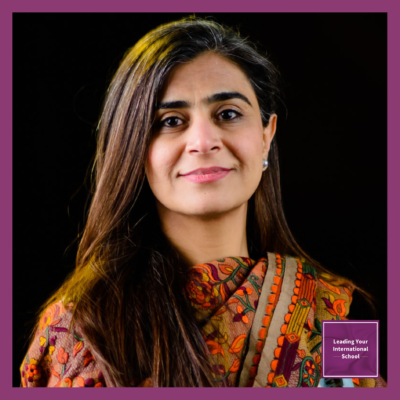
by Kanwal Malik
As school leaders, we spend our days dissecting educational management, leadership theories and accreditation standards. We draft policies designed to level up international school leadership, often focusing on the mechanics of school growth data and curriculum frameworks. But recently, I realised the most profound professional development was not happening in a training room; it was happening at my kitchen table over late-night snacks with my daughters.
My eldest, Subha, is navigating her third year of university, while Sila is in the thick of Grade 10. Both are IB students, products of the very systems I believe in as both an educator and a parent. I decided to step out of my role as an educationist and a policy maker and simply ask: When we give you a real choice, how does it actually feel, as a student and as a person?
When Choice Becomes a Lifeline
As an educational leader, I talk about learning centred leadership as a lofty goal. To Subha, however, it is a lifeline. She told me that having a choice makes her feel “more passionate” about her education. “I feel like I, as an individual, am heard,” she said, her eyes lighting up, “and there is an actual effort to pass on knowledge I will hold onto, which in turn makes me want to work harder for it”. Subha’s insight highlights a critical truth for any leader: passion is not something we can mandate through policy; it is something we unlock through agency. When a student feels their education is for them rather than to them, their entire posture toward learning shifts from passive recipient to active learner.
Sila joined the conversation, agreeing that choice is the engine of engagement. For her, having a say in the “what” and “how” of her day makes her feel “more interested in the topics” and overall “more motivated” to learn. In our schools, we often mistake compliance for engagement; this conversation reminded me that true motivation only blossoms when a student feels their individual voice has weight.
The Weight of Autonomy: When Freedom Meets Responsibility
But then came the honest part, the part we don’t always put in our vision statements or university brochures. Freedom is heavy. I asked them if that freedom, when paired with responsibility, motivates them or scares them. “It does both,” Subha admitted. She explained that while responsibility is more motivating when you have chosen the path, the fear of messing up remains a constant, intimidating companion. Sila’s take was even more poignant. She described the thought of complete freedom as “opening and calm,” yet shadowed by the “unknowing” of the responsibilities that come with it. “I would wonder how far I will have to go,” she confessed.
This is where our school practices often falter. We redesign school leadership to offer agency, but do we provide the safety net for the anxiety that comes with it? True agency requires us to move beyond just giving choice; we must scaffold the fear of messing up that Sila mentioned. In practice, this means creating low-stakes environments where students can pilot their freedom before the high-stakes assessments kick in.
Redefining the Scoreboard
The conversation turned to success. I am often looking at school growth and achievement data, but my daughters see a different scoreboard. Sila shared a frustration I think many IB students feel: teachers often “reteach old topics more difficultly” rather than exploring the new. For her, pride comes from the “newness” of knowledge reflected in her grades. When she masters a truly new concept, she feels “confident, motivated, and proud.”
Subha, looking toward her professional life, offered a perspective that stopped me mid-sip of my tea. In a world of AI, she argued that her Social Science studies are making her more human. She is learning to observe, work with, and learn from people, skills she knows will be her edge in the workplace. This connects directly to how we should view our curriculum; it isn’t just a set of standards, but a tool for discovering professional identity in an automated world.
From Shutting Down to Standing Up
I asked them what happens when learning doesn’t go well. Sila admitted her first instinct is to “shut down.” It’s the “advice and comfort” from friends and family that builds her back up and reminds her to take responsibility.
Subha pointed to her professors. She noted that a “good educator” should call you out when you are not performing, but,(and this is key) they must be “supportive and encouraging at the same time.” This balance is what builds the confidence to tackle challenges rather than retreat. In our schools, this means moving toward a culture of “supportive accountability,” where a student’s humanity is prioritised even when their performance dips.
Reimagining Leadership Through Student Eyes
This dialogue has reinforced my belief in the LYIS Vision: we must have the courage and integrity to Reimagine, Redefine and Redesign school leadership. We cannot redesign what we do not deeply understand from the student’s perspective. As leaders, we often focus on the international leadership barriers, but perhaps the biggest barrier is our own distance from the learner’s experience.
By bringing our kitchen-table conversation with learners into the boardroom, we can ensure our educational management is not just efficient but empathetic.
Based on our kitchen-table policy session, here are my recommendations for fellow leaders:
Audit Your Trust Levels: Without trust, Sila says students “will be unable to pay attention or learn as much in class.” Is trust a measurable, lived part of your school culture?.
Balance Agency with Scaffolding: Responsibility is intimidating. When we offer choice, we must provide the emotional framework and the time for reflection to handle the potential for failure.
Prioritise Human Skills: As Subha noted, “humanity in teaching style” is what motivates people to learn to learn rather than just to pass. Our pedagogy should emphasise observation and collaboration as much as content.
Our mission is to Level Up. Let’s make sure we are levelling up toward a future that is as compassionate as it is rigorous. Does your school’s vision account for the fear that comes with student freedom? Does it translate into teacher agency, if not learner agency? I would love to hear how you balance agency with support in your context.
Kanwal Malik, Head of Education, Beaconhouse SouthEast Asia
featuring Subha Malik and Sila Malik
LYIS is proud to partner with WildChina Education