by André Double
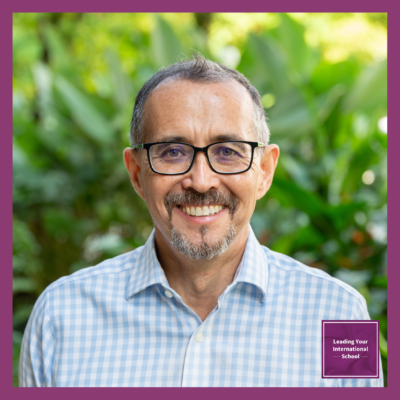
I sat down with Nick Alchin, Head of College at UWC South East Asia, recently, at his home in Singapore. He leads one of the world’s largest international schools of 6,000 students, with two campuses in Singapore. A former IB Chief Assessor for TOK and textbook author. His new book, ‘Connection: A Year of Great Conversations’, is out in 2027. He writes at nickalchin.com.
It was a privilege to be able to share, listen and engage with Nick. A conversation unlike any other I’ve had in international school leadership. Here is what I heard. I am sure the learning will be as big a provocation for you as it was for me.
𝐓𝐡𝐞 𝐀𝐫𝐭 𝐨𝐟 𝐚 𝐆𝐨𝐨𝐝 𝐂𝐨𝐧𝐯𝐞𝐫𝐬𝐚𝐭𝐢𝐨𝐧
Nick is currently writing a book on conversation. I asked him about what underpins the essence of a good conversation. “Well, one part of it is that you have to figure out what you think, and that can happen through talking”, he said. “But you can’t get so caught up in your own view that you forget it is just that – your own view – not the truth. So, you have to remember to hold it lightly enough – with enough humility – that you can hear the other person. You have to always be mindful that your approach might be wrong.”
He introduced me to the ‘conversation pyramid’. Generic talk at the bottom: How are you? The social niceties that grease the wheels of life. Intimate at the top – the unique thing that matters to us personally, that only we can say. I’m struggling and I don’t know why. The art (he suggests) is moving up and down that pyramid intentionally. We can’t stay too long at the intimate level, but if you never reach it, you miss the value within the other person. It was a real lesson for me, as I hope to move up and down the pyramid!
“Being conscious of where you are on that pyramid – ascending and descending it intentionally – can bring out the best in people.” I found myself wondering: In my leadership conversations this week, did I even know what level of the pyramid I was on?
The biggest challenge? Trust has moved.
I asked Nick about emerging trends that worry him. He mentioned the usual AI and enrolments.
But most prominently, he said, is trust. Trust has not gone away, he explained. It has moved. “Once it sat with doctors, churches, schools, governments, corporations. Now it often lands on social media feeds and, dangerously, on whoever shouts loudest,” he said. “And where we once could have been trusted as experts, now we’re increasingly viewed through the lens of suspicion that we are trying to extract from the client,” he said.
For Nick, the real leadership questions of our time are ‘How do we intentionally go about earning trust and not merely demanding it? And how do we hold our ground when we need to, and avoid being seen as not listening, or ever not caring?’ Trust in his words has to be earned case by case. That struck me. How often do we assume trust as a given because of our title?
How do you intentionally go about earning trust and not merely demanding it?
Is it lonely at the top? Yes. But misunderstood.
“I’d say it’s true,” he replied to the old adage. But not for the obvious reasons. He has a strong team. Friends. A supportive wife. The loneliness is not isolation.
“It’s like being ‘misunderstood’, but not in the cliché sense. More like being misread, or even misframed,” he tells me. “Sometimes, I’ll have a perspective on something, and it may sound like I disagree with the person I’m talking to. And of course, I may do, but that’s not really the point. It’s just that as a Head, your job is to carry the broadest perspective; not only the operational or educational, but both. As well as the financial, legal, board and reputational perspectives. So I’m rarely talking with somebody who’s wrong, but it may be that their perspective is one among many, and they may not even be aware of the others. I know I certainly wasn’t before I took this job on, so I don’t hold it against anybody when they can’t see the broadest picture.”
“We need to make time to make ourselves available to the world”
This was the line that stopped me. Nick told me about walking in a park near his home in Singapore. “It was a cool night. A beautiful moon through the trees, but I walked straight past it. In my head, I was planning for the next day,” he said. Adding, “I wasn’t ‘available’ to the world”.
He tells me about the sociologist, Hartmut Rosa, who calls this ‘muting the world’ (Rosa, 2019).
“In certain jobs – and school leadership is one – you sharpen some parts of you and you blunt others to the outside world.” He talks about certain professions where arguing is all that matters and contrasts that to the more human-centered aspects of school leadership. “The danger is not that you become less competent. The danger is that you become less present,” I learn.
Nick told me that he realised this through a medical experience that he and his wife, Ellie, went through together last year. Not only did it save his life, but it gave him a new way to see and engage with the world. “It says something that it took surgery to see this,” he said. “And I’m wondering how we find or make room to be available for our students, for the world, and for ourselves; and I worry if there is, at this moment, in the context I know, some irresolvable tension here.” His voice changed and slowed as he paused and reflected. “I think there may be other ways of being – I’m sorry if that sounds pretentious, I have no other way to describe it – than is commonly available in busy, driven daily life.”
“We need to make time to make ourselves available to the world.”
Sophie’s question: pastoral strengths and how students flourish at UWC
Our LYIS member, Sophie, asked Nick ‘What makes UWC’s pastoral care work so successful and highly regarded?’
Nick gave two answers. First: “People who care, because we are a mission-driven school, people join us for that reason. Not generally for any other.” Second: “The mission itself for peace and a sustainable future that elevates teenagers beyond their own day-to-day concerns. Many believe the world centres around them. We all did. That’s not a criticism in itself. But having that bigger mission piece – ‘Here’s what we’re about. Here’s why we do these things’ – I think that’s what makes students flourish.”
The interesting omission here is the systems or safeguarding protocols. The right people and a real mission. Of course, they exist and everything else is important and has its rightful place, but to Nick, it is the right people who lead them.
Thomas’s question: What sets your leadership apart?
Our LYIS member, Thomas, asked Nick what distinguishes his leadership.
Nick credited teaching Theory of Knowledge and the philosophical underpinnings it has led him to. “To me, philosophy is deeply practical. Being able to draw on Marcus Aurelius, or Montaigne, that allows you to elevate from the everyday into matters of principle.”
“The human condition has not changed,” he argued. “Yes, we have AI. Yes, globalisation is real. But a teenager’s core struggles? A leader’s need for judgment? Those are ancient.” That philosophical stance, he believes, is rarer than it should be. Most of our work is very operational. Some of it is strategic. I’d like to make more of it philosophical. Nick thinks that it is an opportunity for our international schools and their leadership. The question we have, therefore, is how your leadership can become more philosophical and what might that impact be?
𝐀 𝐌𝐲𝐭𝐡: 𝐂𝐨𝐧𝐭𝐞𝐧𝐭 𝐢𝐬 𝐃𝐞𝐚𝐝
I asked Nick for something he once believed that turned out to be wrong.
He paused. Then: “Years ago, I thought content was dying. That skills were everything. Someone corrected me. I thought they were wrong. They were absolutely right.”
He sees the potential danger of teachers who cannot distinguish when an AI output is poor, unworthy, or just not needed, because they do not know the content themselves. “You can only develop real skills if you have content, now more than ever.” I sat and reflected, because I too had dared to believe the same thing. For years, I quietly moved over to the ‘skills over knowledge’ side. Yet Nick admitted he was wrong, and so will I. Knowledge needs to be the fertile ground in which our skills grow, especially (and critically) in an age of misinformation.
Do you still get surprised? Or have you become immune to much of life’s innate beauty?
I asked whether we lose the capacity for surprise. He told me a story.
“Walking through a small school in New England. A bright, cold morning. Beautiful grounds. Children running around, excited by school, but learning, by life, though they would never have put it that way.” He was moved to tears. “I’d seen this elsewhere. Why was I so moved? I don’t know the answer, but I was glad I was; that I still could be; that I had not muted the experience.”
“And I also want to be open to that experience in the mud, the urban rain,” he said. The ability to be surprised and feel such joy, he said, often sits outside education and travel. A general stance in life that allows one to see the beauty in what is around us, rather than what we don’t have.
“The whole of our professional lives is about control,” he reflected. “Control this process. Mitigate that risk. But experiences that are uncontrollable – that cannot be engineered – may have value by nature of their uncontrollability. When you make yourself available, you open yourself up to new ideas.” The lesson I take away: Be bold, take guided risks and engage yourself in unpredictable events and activities where you genuinely don’t know what the outcome will be. Lose yourself in the process.
𝐓𝐡𝐞 𝐐𝐮𝐞𝐬𝐭𝐢𝐨𝐧 𝐓𝐡𝐚𝐭 𝐖𝐞 𝐋𝐞𝐚𝐯𝐞 𝐘𝐨𝐮 𝐰𝐢𝐭𝐡
Nick didn’t leave me with a five-point checklist or a list of ‘how-tos’. This one question, I believe, really, perfectly sums up our afternoon together.
Are you available to the world right now?
Not tomorrow. Not after this or that deadline. Not when the end-of-year strategic plan is finished. At this moment, in this place, are you available to the world right now?
Please do share your thoughts, responses and ideas on Nick’s wonderful philosophical insights.
I am still working on my answer. I suspect you are too.
Thank you to Nick Alchin for his time, his honesty, and for speaking slowly enough that we could all hear. And to Mercy, for the most incredible quiche!
𝐑𝐞𝐟𝐞𝐫𝐞𝐧𝐜𝐞𝐬
Bolman, L.G. and Deal, T.E. (2021) Reframing Organizations: Artistry, Choice, and Leadership. 7th edn. San Francisco: Jossey-Bass.
Rosa, H. (2019) Resonance: A Sociology of Our Relationship to the World. Cambridge: Polity Press.
𝐋𝐢𝐧𝐤𝐬
Nick’s website and blog:https://nickalchin.com/
Forthcoming book (Feb 2027): A Year of Great Conversations (Bloomsbury)
𝐍𝐢𝐜𝐤 𝐀𝐥𝐜𝐡𝐢𝐧, 𝐇𝐞𝐚𝐝 𝐨𝐟 𝐂𝐨𝐥𝐥𝐞𝐠𝐞, 𝐔𝐖𝐂 𝐒𝐨𝐮𝐭𝐡 𝐄𝐚𝐬𝐭 𝐀𝐬𝐢𝐚
𝐀𝐧𝐝𝐫𝐞́ 𝐃𝐨𝐮𝐛𝐥𝐞, 𝐅𝐨𝐮𝐧𝐝𝐞𝐫 & 𝐂𝐄𝐎, 𝐋𝐞𝐚𝐝𝐢𝐧𝐠 𝐘𝐨𝐮𝐫 𝐈𝐧𝐭𝐞𝐫𝐧𝐚𝐭𝐢𝐨𝐧𝐚𝐥 𝐒𝐜𝐡𝐨𝐨𝐥 (𝐋𝐘𝐈𝐒); LYIS is a member organisation and global leadership consultancy. Our mission is to Level Up International School Leadership.
𝐋𝐘𝐈𝐒 𝐢𝐬 𝐩𝐫𝐨𝐮𝐝 𝐭𝐨 𝐩𝐚𝐫𝐭𝐧𝐞𝐫 𝐰𝐢𝐭𝐡 𝐁𝐞𝐲𝐨𝐧𝐝 𝐂𝐥𝐚𝐬𝐬𝐫𝐨𝐨𝐦𝐬